
| Home | Biographies | History | Places | Documents | Letters | Family Tree | Misc | Contact | NEW | Blog |
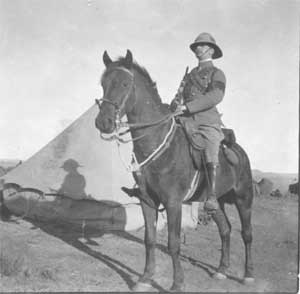
In the 1911 Census he was living with his two brothers Edgar Monteagle BROWNE and Hugh Edgar BROWNE in Kensington at 1 Drayton Gardens, S W London. He was a Lieut Special Reserve. The three brothers were all single at the time. His will probate: BROWNE John Plunkett of 57 Lansdowne-road Holand Park London. Probate London 4 January to Samuel Francis Peter Blythe, solicitor. Effects 1436 9s 8d. Resealed Cairo 24 April 1933. Buried: Cemetery of Kensington & Chelsea, 31 Oxbridge Rd., London, UK. Plot is in Section 173, Plot #88.Added: July 22, 2022. I have three other sources of information on John Plunkett BROWNE. Firstly, an undated and unattributed news clipping in my grandmother's album which says the following:
The Royal Inniskilling Fusiliers Regimental Museum is at: The Castle, Enniskillen, Co. Fermanagh. It may be worth a visit. Tthe 3rd Battalion was a reserve batallian and on August 1914 was in Omagh and remained in Ireland until April 1918 and then moved to England. Given that BROWNE was promoted to Major during the war, it may also be possible that he saw action on the field. Hard to say. In the news announcement of his brother Edgar’s DSO, he is made reference to, so we know that he was still in service in 1917 (as were all four surviving brothers). The next bit of info came from an email from a Margaret Ennis in Belfast who had already tracked down information on Albert Villas for me (where June BROWNE lived at the time of her marriage). (Thanks to the kindness of strangers!) Margaret sent me the map of Knock as it was in 1902 along with the street directory at the time. Albert Villas is just down the road from Holly Park which was owned at the time by John's older brother, James Carlisle Monteagle BROWNE. The house is just at the start of Kings Road, running from the Sandown Road on the right hand side. In fact it is a duplex. On March 20, 2002, Margaret went to the Linen Hall Library and then looked in the 1909 Belfast Street Directory and found that the 1909 occupant of the Albert Villas was Liet. JP BROWNE of the 3rd Royal Inniskilling Fusiliers. She also sent me the photo of the house in its current state:
ADDED INFORMATION: July 21, 2022 John Plunkett BROWNE. · 1874. No birth certificate is recorded at either NI or irishgenealogy. His supposed birth date of 1874 is interesting. His father, John Monteagle BROWNE was a bachelor when he married Susannah EDGAR in September 23. · 1901 Census, resident of House 55 Sandown Road, Pottinger, Co. Down. Age 17, architect pupil. · 1903: The London Gazette, September 11th, 1903: 3rd Battalion, Royal Inniskilling Fusiliers. John Plunkett Browne, Gent, to be Second Lieutenant. Dated 5th September 1903 · 1933. Probate: BROWNE John Plunkett of 57 Lansdowne-road Holland Park London. Probate London 4 January to Samuel Francis Peter Blythe, solicitor. Effects £1436 9s 8d. Resealed Cairo 24 April 1933. · NOTE: It seems that he died unmarried. · News clipping refers to Lieutenant J. Plunkett Browne,3rd Battalion Inniskilling Fusiliers inspecting the troops. He "complimented the lads on their fine and smart appearance". Addressing the company, he "spoke of the advantages of physical drill, especially to lads living in the city, and how necessary it was to have a sound body and good physique to take part successfully in the battle of life". · 1915. The wedding announcement of his brother, Edgar, refers to Captain J. Monteagle Brown who attended, having been wounded at the front. · Thanks to Margaret Ennis in Belfast who found the 1901 record for Albert. There are two houses shown on the Alan Godfrey maps. "On the back of one showing the KNOCK area there is an extract from the street directory at the time (1902). The very first entry to ALBERT VILLAS is at the start of Kings Road, running from the Sandown Road on the right hand side,. This could apply to two houses as the occupants are given as Wilson, J. solicitor and the Cuthbert, Gerald, elec. Engr."[source email, March 18, 2002] On March 20, 2002, Margaret went to the Linen Hall Library and found that the 1909 occupant of the Albert Villas as recorded in the 1909 Belfast Street Directory was Lieut. JP Browne of the 3rd Royal Inniskilling Fusiliers. This is probably the Albertville mentioned as June BROWNE's place of domicile in 1909.SOURCE email # 571 also email #607 "Just past your ancestor's house it says "Sandown Park intersects (in Belfast Directory for 1909). · 1922 When John applied for one of his military medals, his address was 25 Sharia Tewf R, Cairo, Egypt. He was with the Royal Inniskilling Fusiliers, att to/2d Bn, Royal Irish Rifles, Royal Irish Regiment
|
Site Map | Legal Disclaimer | Copyright
© 2003-2023 Sharon Oddie Brown